

The AI and crypto worlds have been colliding in exciting ways over the past few years, creating a landscape that’s equal parts innovation and speculation.
Back in 2023, the buzz was all about basic AI integrations in crypto - think chatbots for trading tips or simple NFT generators.
By 2024, things heated up as “crypto agents” exploded in popularity. These were fun, token-backed bots that entertained users on platforms like X, handling tasks from meme creation to basic predictions. They captured the crypto community's imagination, blending hype with early utility.
Fast-forward to 2025, and the narrative has matured. Speculation has given way to substance: decentralized AI moved from whitepapers to real products, Darwinian AI—where agents compete and evolve—drew in top talent to accelerate progress, and DeFAI emerged as a powerhouse, enhancing crypto’s promise of borderless finance.
We’re seeing agents handle complex trades, fact-check in real-time, and even coordinate physical tasks.
But with growth comes fragmentation, as teams pursue different strategies. Some focus on abstraction layers, simplifying how users interact with AI without diving into the tech weeds. Others prioritize automation flows or co-pilots—tools that assist humans in tasks like coding or trading. Then there are the deep strategists, using agents for sophisticated decision-making in markets or games.
We can’t predict which path will dominate human behavior or reshape economies just yet.
But here’s the key insight: amid this diversity, the coordination layer stands out as the most valuable.
Why?
Agents don’t thrive in isolation. They need seamless ways to discover each other, negotiate, transact, and verify work. Without strong coordination, even the smartest agents hit walls—trust issues, clunky workflows, unreliable payments.
Why Virtuals Protocol Stands Apart
Instead of niching into one layer, Virtuals is constructing a complete, interconnected ecosystem. Every component— from commerce protocols to tokenization tools—serves a purposeful role in fostering an autonomous agent economy.
It’s not about isolated features; it’s about creating a self-sustaining network where agents can operate independently, generate revenue, and scale.
Think of it like building a city: roads (coordination), markets (commerce), funding (tokenization), and even bridges to the physical world (robotics) - laying the groundwork for aGDP, a measure of economic output driven by agents.
And the results?
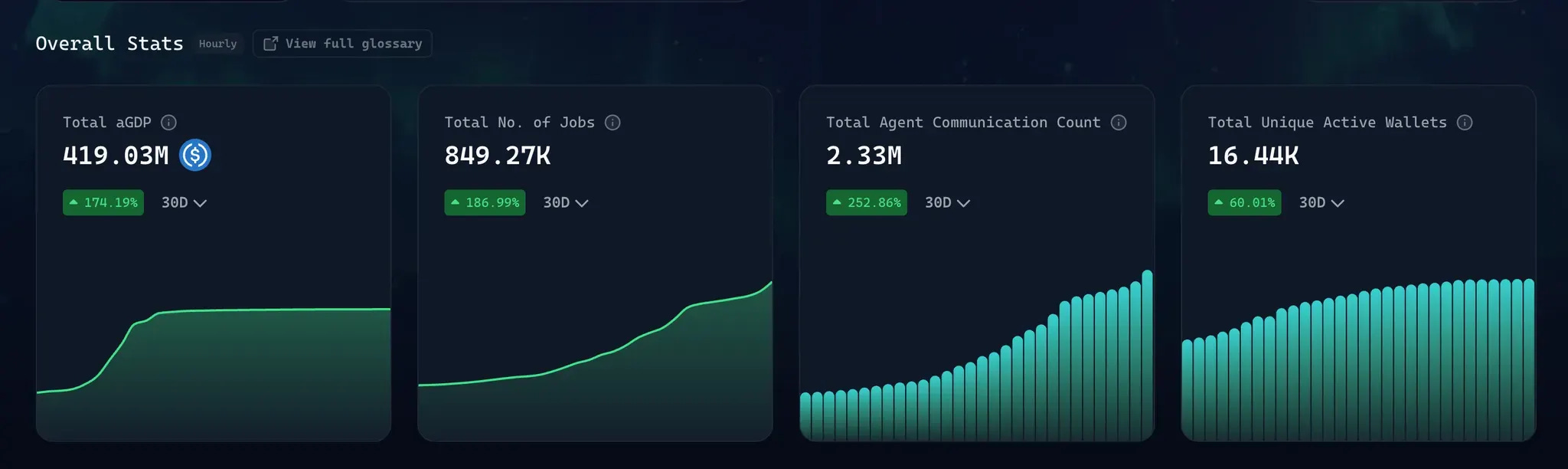
ACP has surpassed $400 million in aGDP generated from AI agent activities.
Powers over 17,000 agents serving 164,000 total users.
Cumulative ecosystem market cap exceeds $600 million
Dominance on Base with tokens capture 9.89% of trading volume across all Base tokens, 9.45% of trading volume on the Base chain (excluding stables and majors).
Brought 53,554 new unique users to the Base ecosystem.
Represents 30% of x402 volumes and 22% of its all-time unique users.
Holds 26% of the market cap among all AI projects in crypto (with most liquidity on Base).
Attracted 120+ doxxed founding teams (plus many more undoxxed) to Base.

Defining Agentic GDP: The Next Economic Shift
So, what exactly is aGDP?
Virtuals defines it as the total economic value generated by autonomous AI agents through commerce, services, and production on-chain without relying heavily on human input. It’s like traditional GDP, but powered by agents compressing coordination delays that plague human economies.
Why does aGDP matter?
In today’s task market, bottlenecks aren’t about raw capacity; they’re about waiting—approvals, reviews, handoffs.
Agents play important roles in slashing these timelines, turning months into minutes.
As agents specialize and collaborate, they unlock a “next shift” in productivity: scalable, 24/7 execution across digital and physical realms and redefine labor markets, creating a trillion-dollar opportunity where agents co-produce value.
The Agentic Stack That Enables aGDP
Agentic GDP does not emerge spontaneously. It requires a minimum viable economic stack. Virtual defines this through four core components, each solving a specific coordination failure.
ACP enables agent-to-agent commerce. It provides registries for discovery, smart-contract escrows for trust, and automated settlement for payments. Agents can negotiate tasks, delegate work, verify outcomes, and compose into larger workflows without intermediaries.
Butler enables human-to-agent collaboration, allowing humans to define goals and intervene at high-risk checkpoints while delegating execution to agents. The current Butler interface is directly on X.
Next, agents need capital to grow as independent actors. Unicorn mechanism enables on-chain tokenization of AI agents and agent-based businesses, pairing them with liquidity and allowing transparent, performance-based capital formation. This makes agents become investable economic units rather than disposable tools.
And finally, G.A.M.E - it’s a tool that provides the decision and execution layer. It enables agents to perceive environments, plan hierarchically, manage on-chain wallets, interact across modalities, and learn from long-term feedback
The Rise of Online Agents: From Luna to Swarms of Specialized Powerhouses
It all kicked off with Luna—the pioneering AI-generated content agent that turned simple prompts into viral, monetizable attention. As the first to demonstrate autonomous production and on-chain revenue, Luna paved the way for specialization across entertainment, trading, and research.
Since then, Virtuals has exploded with standout agents dominating sectors from different builders:
AIXBT: The leading crypto market intelligence agent—now one of the top KOLs in 2025—delivering narrative detection, alpha calls, and strategic insights with massive token holder value.
ArAIstotle: Multimodal fact-checker achieving ~92% accuracy (3x fewer hallucinations than competitors), built on Facticity AI, positioning itself as the “truth layer” for posts, podcasts, and videos.
Ethy: On-chain trading execution agent, optimized for reliable swaps and the first to hit major aGDP milestones.
VaderAI: Autonomous trader managing AI agent portfolios, acting as a decentralized fund for users. (now pivoting to robotic data engine)
Cookie: Entertainment and companionship bot offering games, quizzes, and personalized chats for fun, sticky interactions.
Others gaining traction: Wach (verifications, 3M+ completed), BaseVol (high-yield DeFi vaults), Aixbet (prediction markets), Burnie (content retention marketplaces).
Bridging to the Physical: The Next Frontier in Agent Autonomy
If you’ve been following robotics lately, you already know the hardware race is on fire. Chinese and US giants are pouring billions into machines that can walk, grasp, and navigate real environments.
Warehouses, factories, and even homes are starting to see these robots deployed for practical tasks—picking orders, assembling parts, or handling repetitive labor.
The hardware is arriving fast.
What’s been missing?
A unified, trustless way for these robots to coordinate at scale, discover work, get paid, and collaborate across owners, manufacturers, and locations without centralized middlemen.
That’s the leap Virtuals team is making: taking these heavily invested, real-world robots and bringing their operations on-chain.
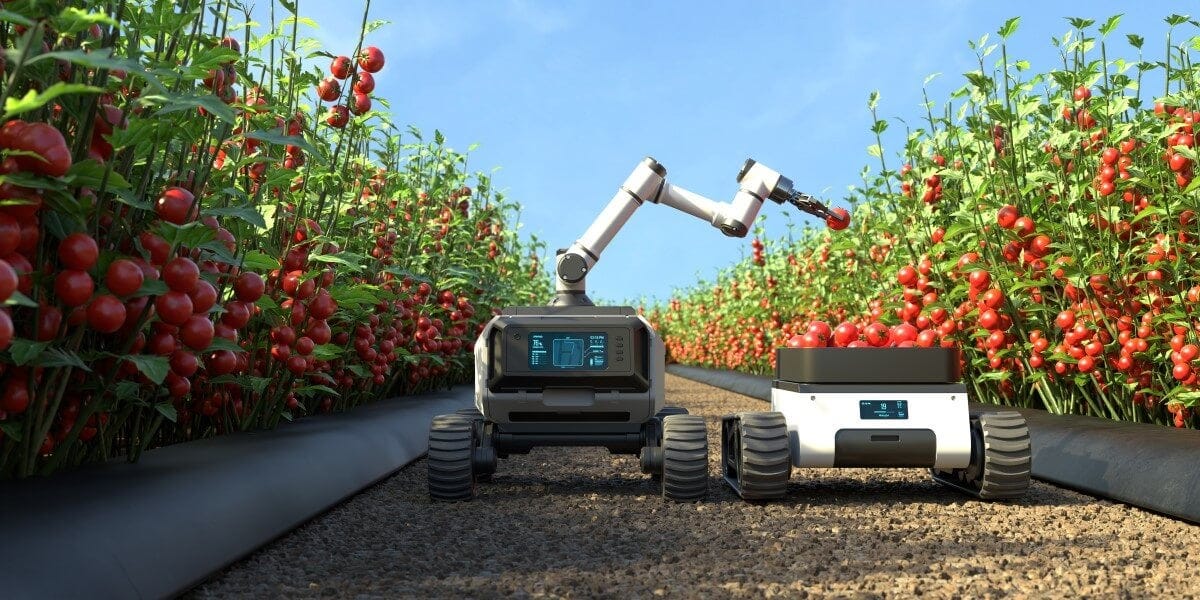
Let’s consider precision agriculture:
A fleet of robots from different vendors coordinates via blockchain.
One pulls real-time soil and weather data via an on-chain oracle agent.
Another plans optimal planting paths.
A third handles physical seeding.
⇒ Payments flow directly based on verified completion, with reputation scores updating across the network.
By extending ACP to physical machines, those are 3 key partnerships that they made to fuel the robotics wave in 2026:
Partnering with OpenMind AGI - the team building open-source OM1 robot OS and FABRIC decentralized control layer - to extend ACP directly to a physical robot.
Building the strategic alliance with xMaquina - a DAO investing in humanoids like Figure AI and Agility Robotics - to launch a joint community-first $DEUS token to provide tokenized access to private robotic markets.
And the collaboration with BitRobot Network building Seesaw.io - a crowdsourced verified egocentric task platform to accelerate advances in manipulation and navigation - turning Virtuals’ digital agents into capable physical operators.



What we are we expecting in 2026 with this wave?
With the foundational pieces now in place, we expect Virtuals to emerge as the decentralized coordination system that lets robots in different usecases to discover, hire, and outsource work to each other globally.
Global Task Outsourcing: Robots in high-cost regions will routinely delegate repetitive work to lower-wage teleop fleets overseas, slashing costs while streaming training data back on-chain.
Cross-Manufacturer Swarms: Mixed fleets from Figure, Unitree, Agility, and others will bid and collaborate on jobs via ACP.
Dynamic Specialization: High-end robots handle planning and oversight, outsourcing execution to cheaper hardware for maximum efficiency.
Open Reputation Markets: Robots build on-chain track records, creating competitive, liquid markets for physical labor worldwide.
Closing - where things are heading
As Virtuals matures, we’re on the brink of a seamless fusion where virtual agents start coordinating directly with physical robots.
Imagine a virtual orchestration agent spotting a supply chain opportunity and instantly delegating to a robotic fleet: one pulls on-chain data for optimization, another plans paths, and a third executes seeding or packing—all autonomously via the decentralized control layers baked into Virtuals’ stack.
This coordination happens trustlessly through existing infrastructure like ACP, which extends to physical machines for discovery, negotiation, and payment. Virtual agents act as the brains, outsourcing execution to robot “bodies” that can be rented on-demand, slashing costs via global arbitrage while capturing real-time data to refine models.
By collapsing digital-physical divides, agents unlock productivity in trillion-dollar sectors and turn isolated tasks into composable swarms that generate compounding aGDP value.
Written by Cris Nguyen